The Mini Apps
Small single-purpose tools, each with its own visual identity. Six pull live data, one reads files you export yourself, two track what you tap, and the rest need nothing but a browser.
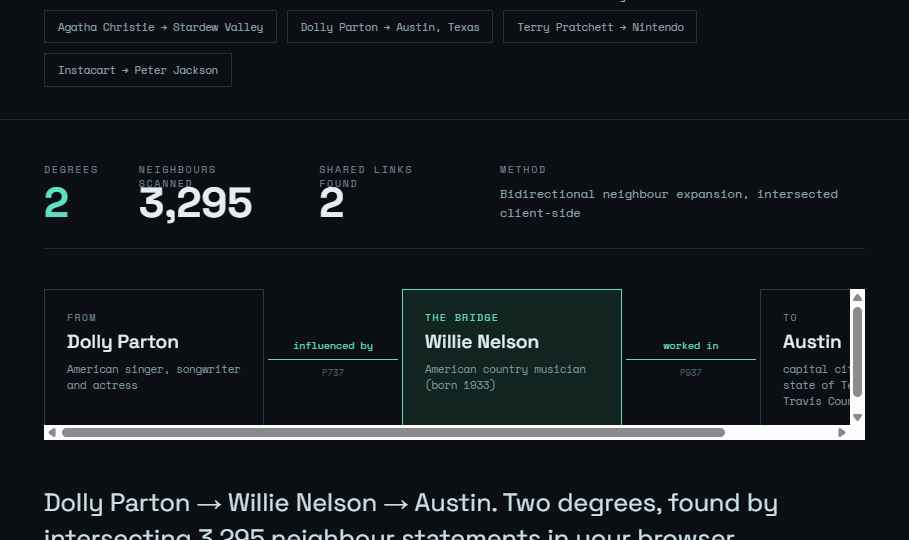
Two things — people, films, bands, companies, towns — and the shortest path between them. Dolly Parton reaches Austin through Willie Nelson, who she influenced and who worked there.
Wikidata search API + SPARQL — live, keyless
Entity resolution, bidirectional neighbour expansion, client-side intersection, property-specificity ranking
Graph search
A queue, a visited set, and cached frontiers gets you past the current two-and-a-half hop ceiling without hammering the endpoint.
Replace the row of cards with an animated force layout: nodes settle, the winning path lights up, rejected bridges fade out.
Daily pair, guess the bridge before revealing, score by degrees. Turns a lookup into something people return to.
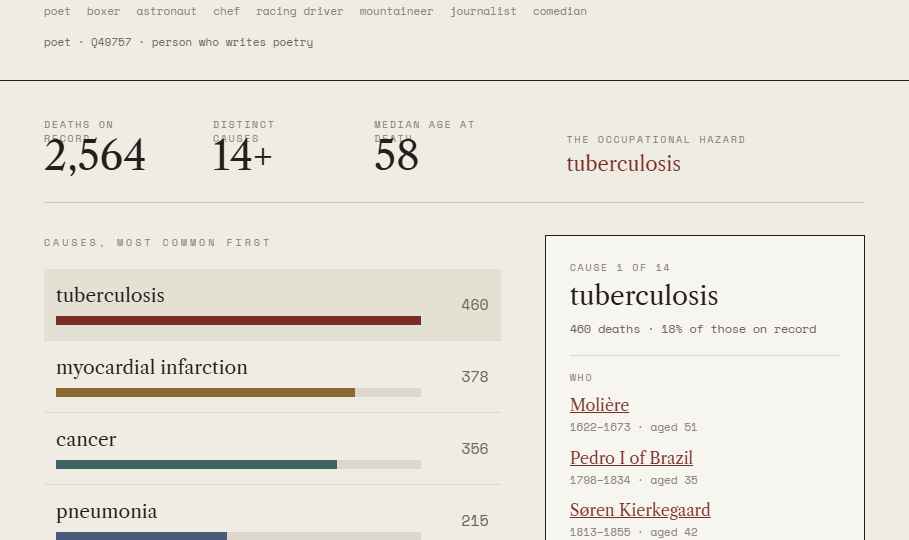
Pick a trade and Wikidata reports how its people actually died. Poets: tuberculosis leads at 460 of 2,564 recorded deaths, median age 58. Click any cause to see who.
Wikidata SPARQL — live, keyless
Aggregate COUNT query plus a separate sample query for names, median age computed in-browser
Mortality analysis
Tuberculosis wins any pre-1950 trade. Bucket by era and the real occupational hazards surface.
Boxers against poets on one axis. Comparison is where this stops being trivia and starts being analysis.
Deaths accumulating along a timeline as bars fill, so you watch a profession's mortality shape build.
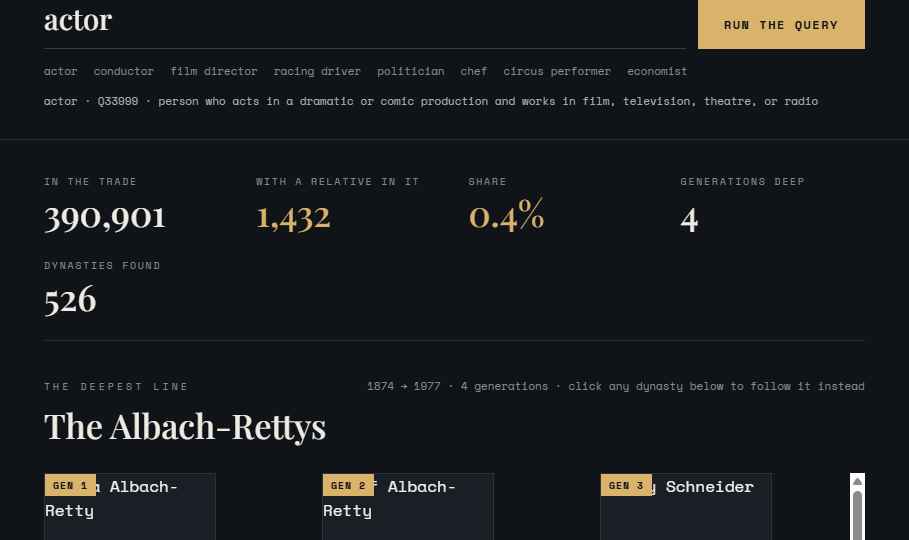
Which professions run in families. Of 25,885 conductors in Wikidata, 347 have a parent, child, or sibling who was also a conductor — and the Stamitz and Newman lines run deep.
Wikidata SPARQL — live, keyless
VALUES-bound property instead of a 4-way UNION (1s instead of a timeout), pair de-duplication, ratio against a total-count query
Social-structure analysis
Conductor vs economist vs racing driver on one screen — the interesting claim is which trade is most hereditary.
Let a dynasty keep going when descendants changed profession, so the Coppolas stay one family across directing and acting.
Portraits already stagger in; add a vertical family tree that grows downward generation by generation.
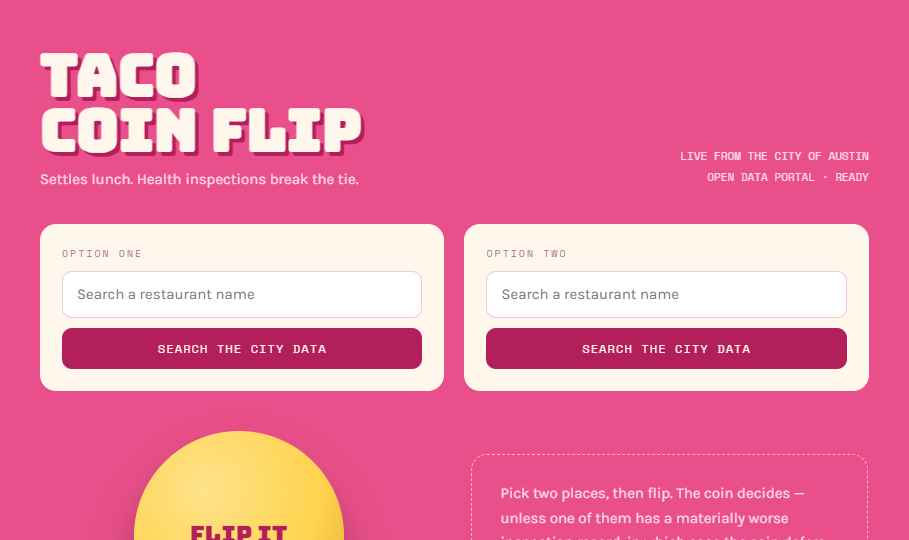
Settles a lunch argument between two Austin restaurants. Search either one against the city's real inspection records, flip the coin, and if one place scored materially worse the coin defers to the cleaner option.
data.austintexas.gov (Socrata) — live, keyless
SoQL query, grouped by facility_id, full inspection history per venue
Civic data toy
Geocode both picks and draw the walk between them.
Geolocation plus a radius query turns the joke into a weekly-use tool.
A real 3D coin with a settle-and-wobble landing, then the verdict typing in underneath.
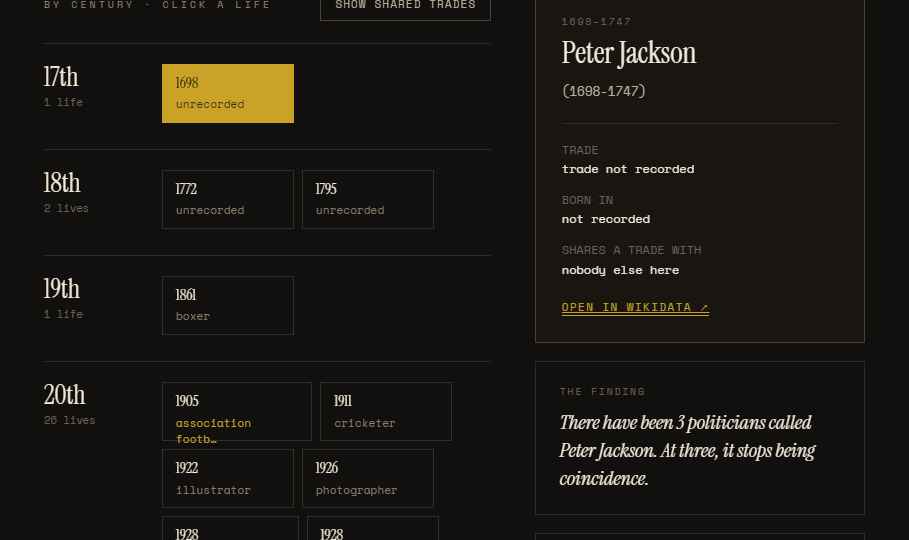
Type a name and it finds every human in Wikidata who carried it, laid out three ways: a packed timeline by birth year, a constellation joining people who shared a line of work, and the plain list.
query.wikidata.org SPARQL — live, keyless
GROUP_CONCAT aggregation, greedy lane packing, client-side edge building
Data visualisation
Compare namesakes and see which name skews to which trade and era.
Birthplaces plotted, so you watch a name migrate across centuries.
Columns filling in chronological order on load, so the shape of the name arrives over time rather than all at once.

Picks your next mystery by mood rather than publication order. Import your Goodreads or StoryGraph export and it learns which authors you return to, then ranks accordingly. “Go deeper” swaps the curated pool for live records from Open Library.
Open Library subjects API (live) + Goodreads / StoryGraph CSV
CSV parsing with quoted-field handling, author-affinity weighting, redacted body count
Recommender
‘Not tonight’ should weigh as heavily as ‘I’ll read it.’
A profile built from your log: short, fair, mean, nothing over 400 pages.
Card flips from a face-down deck, spine-out shelf of what you’ve read building alongside.
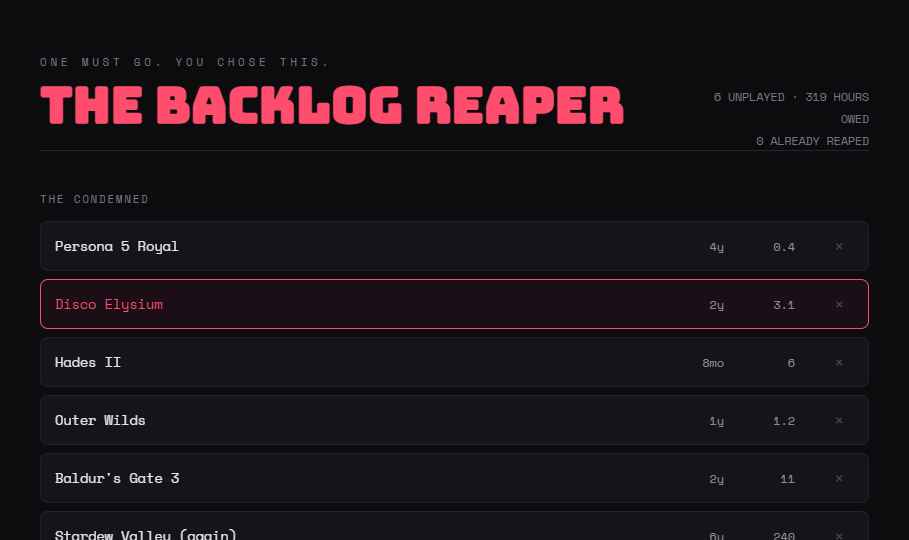
Your unplayed pile, scored by guilt — years owned weighed against hours actually played — and one title condemned. Delete it forever or spare it like a coward. Import your real Steam library by pasting the JSON you fetched yourself.
Steam GetOwnedGames JSON, or plain text lines (any platform)
Dual-format parser, guilt scoring, persistent graveyard
Decision tool
Track reprieves and call them out the second time around.
Paste prices and show the guilt in dollars, not counts.
The condemned row struck through, greying, then sliding into the graveyard.
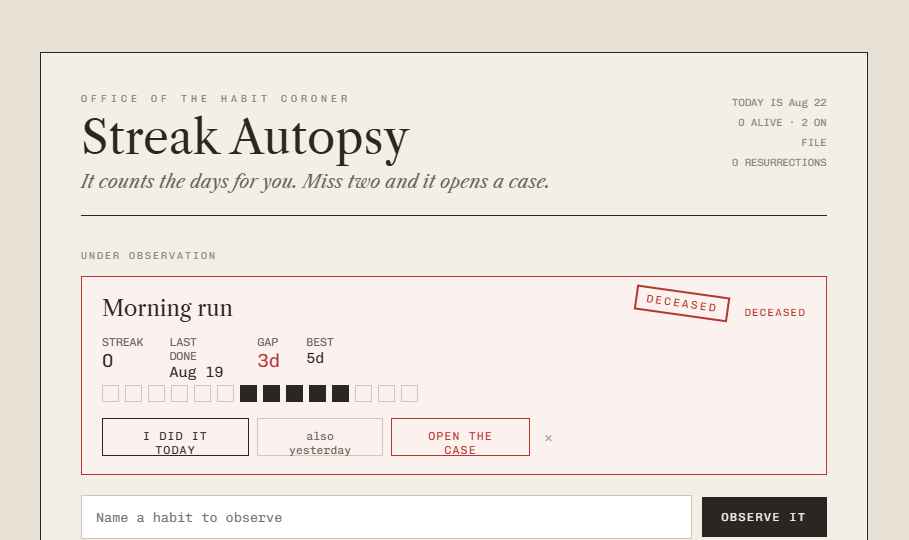
A habit tracker that only gets interesting when you fail. It counts the days itself — tap done, watch the streak — and at a two-day gap it stamps the habit DECEASED, opens a case file, and asks exactly one question about why.
Your own taps, in localStorage
Date-keyed logs, streak and best-run computation, repeat-cause detection
Personal tracker
It knows rain kills your streaks; one keyless weather call makes it an early-warning system.
A shareable image per case, stamped and dated.
Days filling left to right on load, with the gap opening up as a visible break.
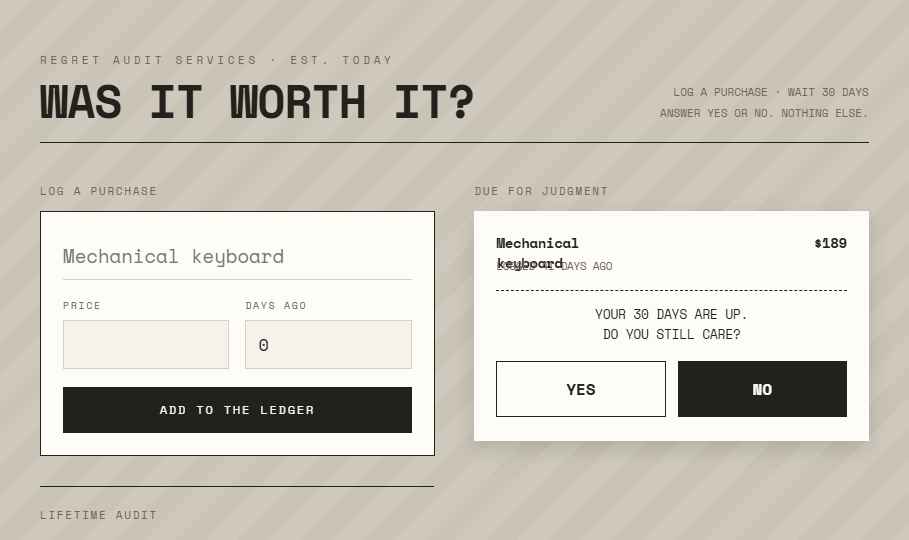
Log a purchase. Thirty days later it asks whether you still care, and takes only yes or no. The receipt keeps your lifetime regret rate, which is the number nobody tracks and everybody should.
Manual entry, in localStorage
Judgment queue gated by elapsed days, regret-rate aggregation
Personal ledger
Cluster regrets by price band and time of day: ‘70% of purchases over $150 made on weeknights.’
Bulk-load a month so the 30-day clock starts properly.
It should print — paper feeding up, line items landing one at a time.
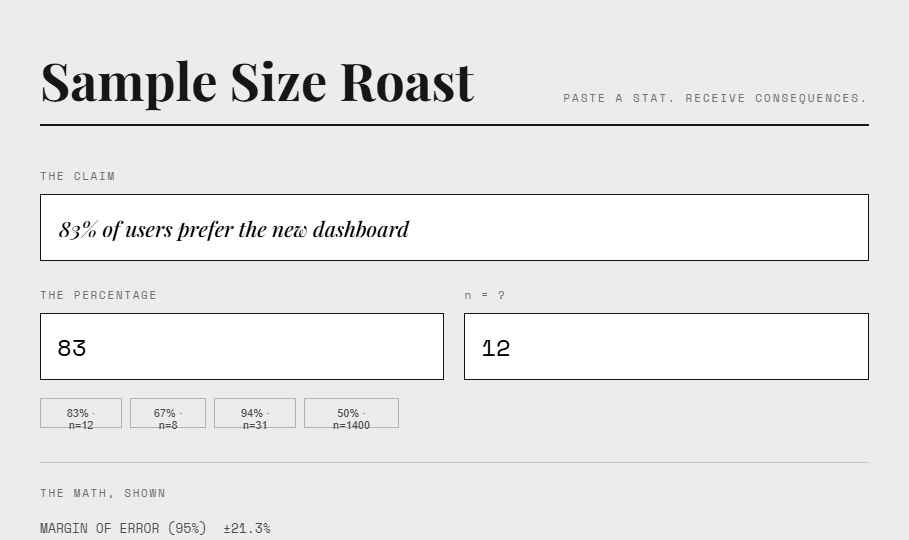
Paste a percentage claim, give it n, and receive consequences. Real Wald margin-of-error maths, a verdict tier, the interval drawn to scale, and a copyable honest rewrite of the stat.
Whatever you type
p̂ ± 1.96√(p̂(1−p̂)/n), required-n solve, tiered verdicts
Statistics literacy
Roast any stat on the page you’re reading.
Test whether the gap between two percentages is significant at all — the mistake people actually make.
The confidence band snapping wider as n falls, so you feel the uncertainty.
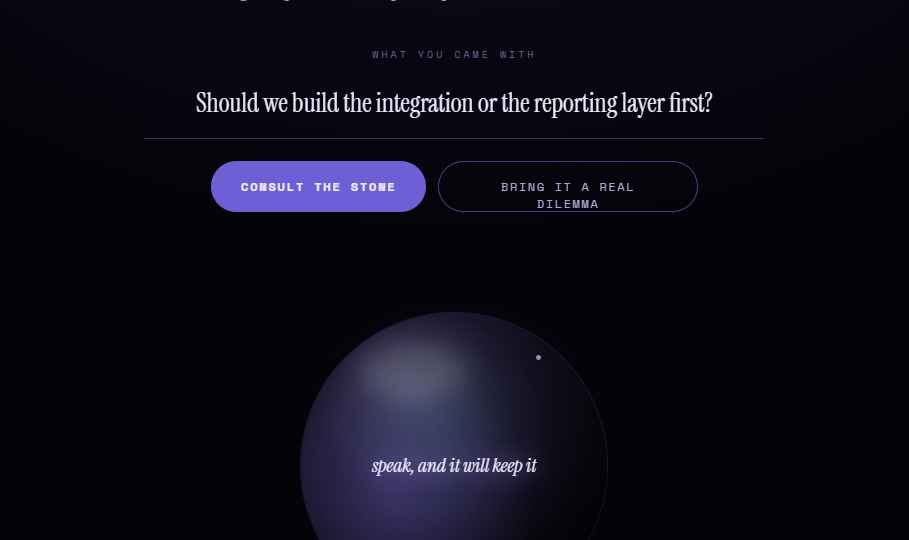
An obsidian scrying stone that never answers. Ask it anything and it hands back a harder question, which it then loads into the input so the next consult goes one level deeper. Five descents, then it goes dark.
None — a rule ladder over your phrasing
Keyword routing on turn one, fixed descent ladder after, session chain log
Thinking tool
Keep the ladder as fallback; show both answers and label which is which.
A shareable transcript of the five questions you were asked.
Smoke that reacts to the question’s length, text surfacing character by character.

A fourteen-card deck of SQL clauses, upright or reversed, dealt into past, present, and ships-to-prod. It reads the spread and then assembles the query the cards imply.
None — the deck is the data
Weighted deal, reversal states, spread-driven query assembly
Whimsy with domain knowledge
Point the spread at a public dataset and return real rows.
Keep past spreads so patterns emerge across days.
Cards flipping from a face-down deck with a slight rotation, reversed ones landing upside down.
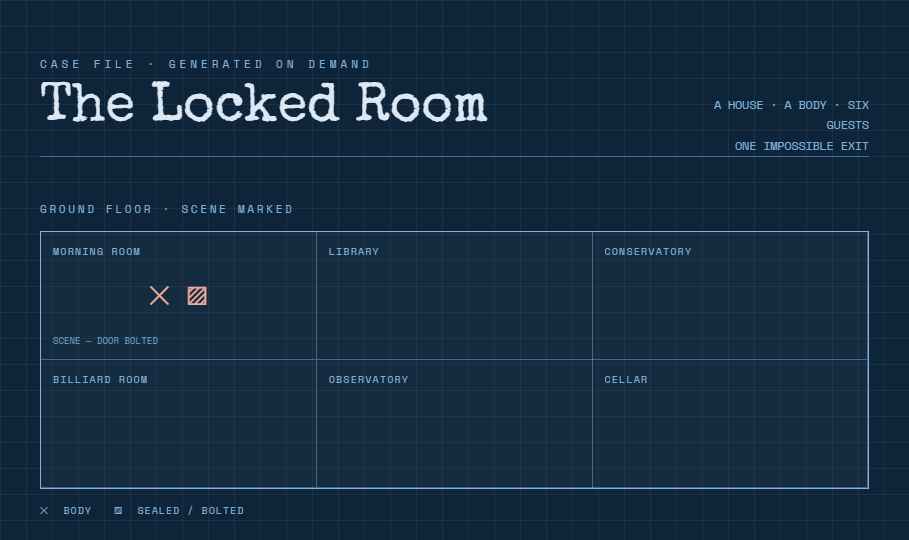
A house, a body, six guests, one impossible exit. Generates the floor plan, the particulars, the suspect list, and — on request — how it was actually done.
None — combinatorial generation
Seeded shuffles, scene-consistent plan marking, solution reveal
Generative fiction
Click rooms to place suspects, commit to an accusation, then reveal.
Track how often you were right.
The solution typing out like a detective’s summation, plan annotating itself as it goes.
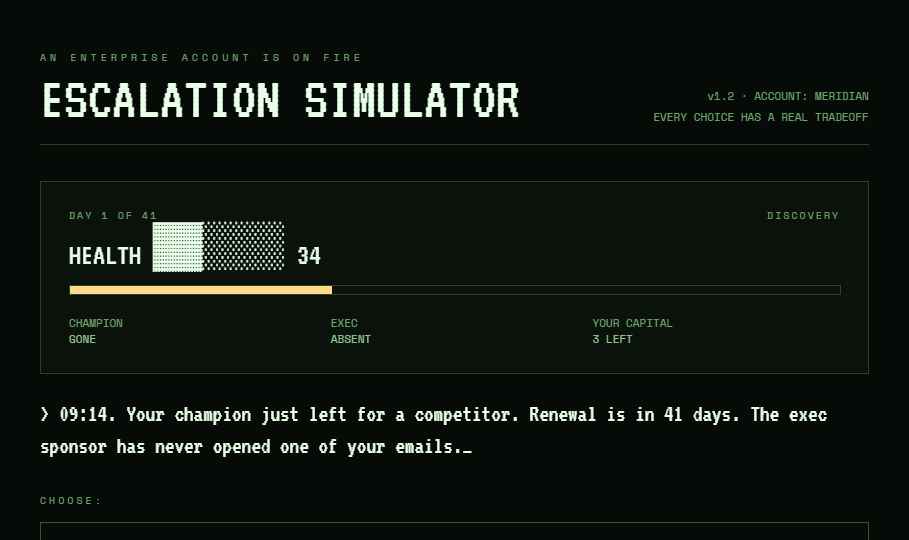
An enterprise account is on fire and you have five decisions. Every choice moves account health, champion status, and your internal capital, and each one names the real tradeoff afterwards. Four endings.
None — hand-authored decision tree
State machine over health / capital / relationships, outcome branching
Domain expertise as a game
Reveal what the other branches would have done to account health.
Cite the account-management frameworks behind each tradeoff so it teaches, not just tests.
Ticking down in real time after each choice, with the log typing in beneath.
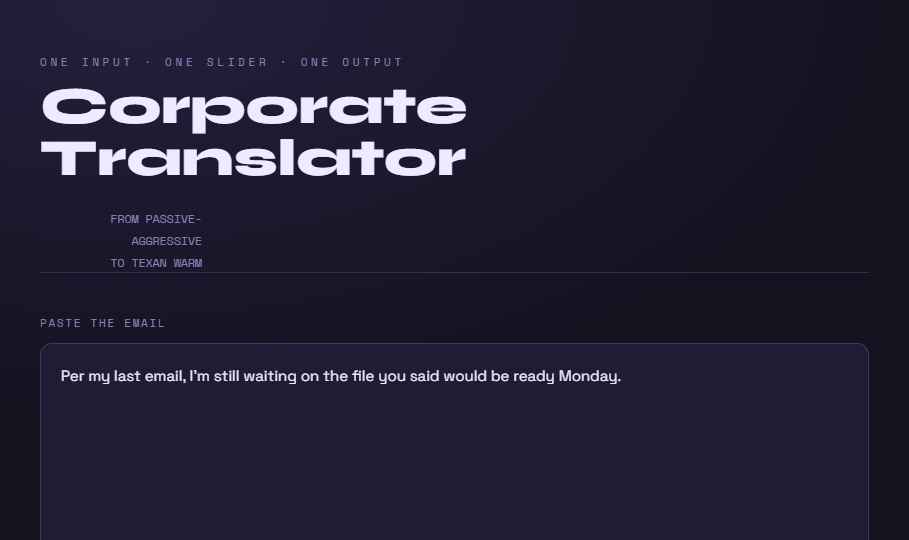
Paste an email and slide from passive-aggressive to Texan warm. The slider genuinely rewrites the text at five stops, counts the passive tells it found, and states the honest subtext underneath.
Whatever you paste
Ordered regex substitution table, tell detection, subtext inference
Language tool
Same input, both engines, labelled. Shows you know where deterministic rules win.
Paste a received email and have it read the subtext back to you.
Text morphing word by word as the tone moves, rather than snapping between stops.